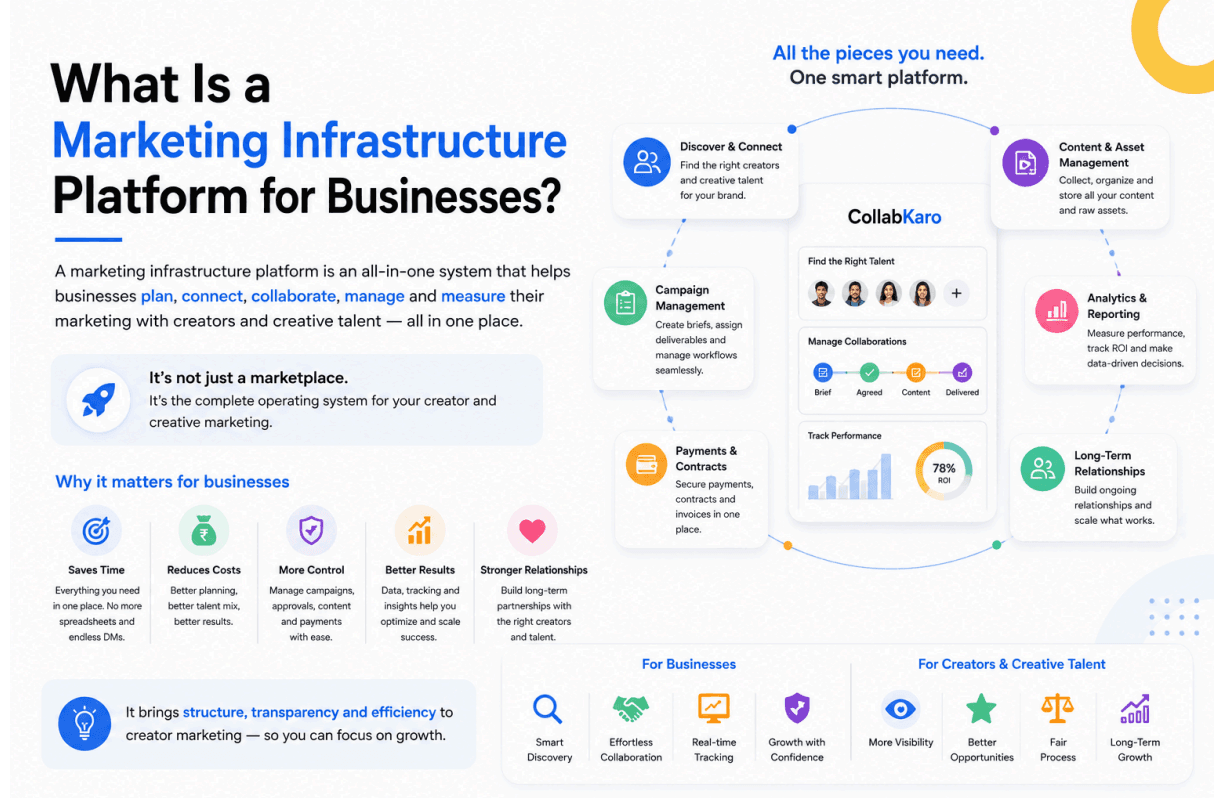
Businesses don't just need marketing ideas. They need marketing structure. Every growing business today knows one thing clearly:
Online marketing is important. They know they need content. They know they need visibility.
They know they may need creators. They know they may need reels, designs, ads, social media management, and brand awareness. But the real problem starts after that.
Most businesses don't know:
- where to start
- how much to spend
- whom to work with
- what kind of creators to choose
- how to divide the budget
- what deliverables are realistic
- how to manage execution
- how to track results
So even when a business has the intention to grow online, the process becomes confusing. They may hire one influencer randomly. They may ask a designer to make a few posts.
They may message creators on Instagram. They may ask someone to edit reels. They may try ads without enough content.
Everything happens in pieces. But marketing does not work best when it is scattered. Marketing works better when it is structured.
That is where the idea of a marketing infrastructure platform comes in.
A marketing infrastructure platform is not just a website with profiles.
A normal marketplace may help a business find people. But a marketing infrastructure platform should help a business make better decisions. It should not only answer:
"Who is available?" It should also help answer:
"Who is right for this business?" "How should this budget be used?" "What kind of marketing mix makes sense?"
"What results are realistic?" "How should the campaign be managed?" That is the difference.
A business does not just need a list of influencers. A business needs clarity.
Businesses need more than influencers.
Influencer marketing is powerful, but it is only one part of online marketing. A business may also need:
- UGC creators
- video editors
- graphic designers
- social media managers
- photographers
- content writers
- campaign strategists
- ad support
- brand storytellers
For example, a skincare business may need creators to promote the product. But it may also need:
- product reels
- before-after content
- Instagram creatives
- testimonial videos
- edited ad videos
- social media posting
- campaign reporting
If the business only hires influencers but ignores content production, design, editing, and execution, the campaign may not perform properly. That is why online marketing needs a full support system.
The real problem is budget confusion.
Let's say a business has ₹1,00,000 for marketing. The question is not only:
"Which influencer should we hire?" The better question is:
"How should this ₹1,00,000 be divided?" Should ₹50,000 go into creators? Should ₹20,000 go into video editing?
Should ₹15,000 go into graphic design? Should some amount go into social media management? Should there be a budget for UGC content?
Should there be money kept for campaign tracking? Most businesses don't have a clear answer. So they either overspend in one place or underinvest in the parts that actually make the campaign work.
A marketing infrastructure platform should help businesses understand how to use their budget more intelligently.
Example: A fitness business with ₹1 lakh budget
Imagine a fitness or yoga business wants to promote itself online. Instead of randomly spending the entire ₹1 lakh on influencers, a more structured plan could look like this:
- ₹40,000 for niche fitness/yoga creators
- ₹20,000 for UGC content or video production
- ₹15,000 for video editing
- ₹15,000 for graphic design and social creatives
- ₹10,000 for campaign tracking and optimization
This is not a fixed formula. But it shows the difference between random spending and planned marketing. The goal is not just to spend money.
The goal is to make the budget work smarter.
A good platform should also warn businesses when expectations are unrealistic.
Many businesses have big expectations with small budgets. For example, a business may say:
"We want 10 influencers, 50 reels, 1 million views, full social media handling, and guaranteed sales in ₹10,000." But that is not realistic. A useful marketing platform should not blindly accept every requirement.
It should guide the business honestly. It should say:
"This requirement is higher than the current budget. Either increase the budget or reduce the campaign scope." This kind of clarity can save businesses from disappointment. It also helps creators and creative professionals avoid unfair expectations.
Creator discovery should be based on fit, not just follower count.
One of the biggest mistakes businesses make is choosing creators only by followers. But follower count does not always mean campaign success. A creator with a smaller but highly relevant audience may perform better than a creator with a huge but mixed audience.
For example, if a yoga business wants to promote its service, a niche yoga creator with a focused audience may be a better choice than a general lifestyle influencer with more followers. So a marketing infrastructure platform should help businesses evaluate creators based on:
- niche relevance
- content quality
- audience fit
- engagement quality
- budget compatibility
- campaign goal
- location
- reliability
- expected deliverables
Not just follower count.
The future is not random DMs. The future is structured marketing.
Today, many businesses still depend on Instagram DMs, WhatsApp messages, referrals, and manual searching. This creates a messy process. A business has to:
- message creators
- ask for rates
- compare profiles
- check content
- negotiate deliverables
- remember deadlines
- manage approvals
- track payments
- measure results
This is too scattered. A better system should bring everything into one structured flow. The business should be able to come to one platform, enter its requirements, get guidance, discover the right people, and manage execution more clearly.
This is what CollabKaro is building.
At CollabKaro, we are building a platform that helps businesses plan, find, execute, and track online marketing more efficiently. We are starting with creator-led marketing because that is one of the biggest pain points today. Businesses struggle to find the right creators.
Creators struggle to get visibility. Collaborations often happen through random DMs and scattered conversations. But our larger vision is to support more than just influencer collaborations.
We want CollabKaro to help businesses discover:
- influencers
- UGC creators
- video editors
- graphic designers
- social media managers
- content writers
- photographers
- campaign support
And in the future, we want the platform to help businesses understand how to divide budgets, what roles they need, what expectations are realistic, and how to execute campaigns better.
CollabKaro is not just about finding people. It is about building clarity.
A business should not have to guess everything. It should not have to randomly ask:
"Should we hire an influencer?" "Should we get a designer?" "Should we make reels?"
"How much should we spend?" "Is this budget enough?" A good platform should help answer these questions.
That is the direction CollabKaro is moving toward. Not just a listing website. Not just a creator database.
Not just a DM replacement. But a structured platform where businesses can make better marketing decisions.
Final thought
Online marketing is becoming more important every day. But for many businesses, it is still confusing, scattered, and difficult to manage. They don't just need more options.
They need better direction. They need the right creators. They need the right creative talent.
They need realistic budget planning. They need structured execution. That is why the future of marketing for businesses will not only be about hiring influencers.
It will be about building a complete support system around marketing. And that is the future CollabKaro is building for.