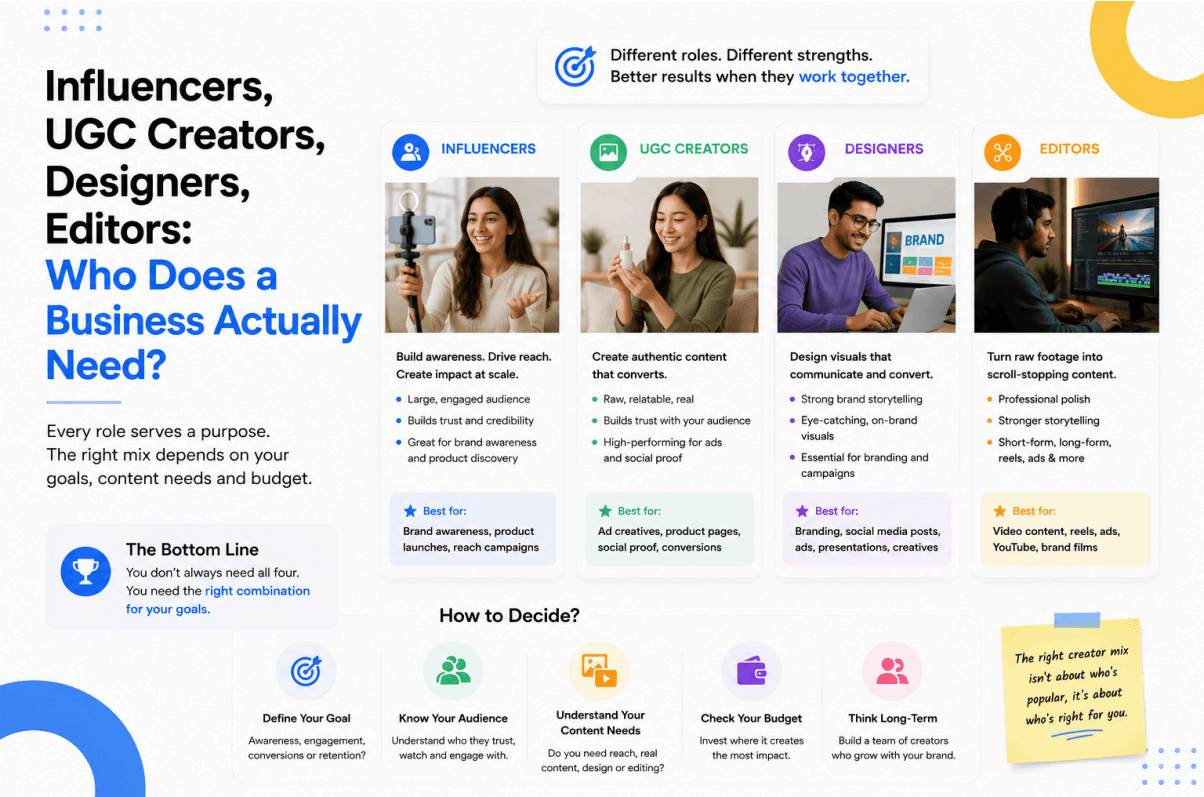
Most businesses know they need marketing. But they don't always know who they actually need. When a business starts thinking about online marketing, the first thought is usually:
"We should collaborate with influencers." And yes, influencers can help. They can bring attention.
They can build trust. They can introduce a product or service to a new audience. But influencer marketing is only one part of online marketing.
A business may also need content. It may need edited reels. It may need good designs.
It may need someone to manage social media. It may need UGC videos. It may need a proper campaign plan.
This is where many businesses get confused. They either hire only influencers and expect everything to work, or they randomly hire different people without understanding what role each person plays. The result?
Money gets spent, but the campaign still feels incomplete. That is why businesses need to understand the difference between influencers, UGC creators, designers, editors, and social media managers. Because each role solves a different problem.
1. Influencers: For reach, trust, and audience attention
Influencers are people who already have an audience. A business works with influencers when it wants to reach people through someone they already follow and trust. An influencer can help with:
- product promotions
- brand awareness
- launch campaigns
- trust building
- audience reach
- social proof
- niche discovery
For example, if a fitness business wants to promote a yoga mat, working with fitness or yoga influencers makes sense because their audience already cares about health, fitness, workouts, and wellness. But the important point is this:
An influencer should not be selected only by follower count. A smaller creator with a focused audience can sometimes be more useful than a bigger creator with a mixed audience. A business should ask:
- Does this influencer's audience match our target customer?
- Does their content naturally fit our product?
- Do people trust their recommendations?
- Is their niche relevant?
- Is their pricing suitable for our budget?
Influencers are useful when the business needs visibility and trust. But they are not always enough.
2. UGC Creators: For authentic content that feels real
UGC means user-generated content. A UGC creator may not always have a huge audience. Their main value is not reach. Their main value is content creation. They create videos or photos that look natural, relatable, and customer-like.
A business can use this content on:
- Instagram reels
- ads
- website pages
- product pages
- testimonials
- social media posts
- landing pages
For example, a skincare business may hire a UGC creator to make a video like:
"I used this product for 7 days and here's what I noticed." This type of content can feel more real than a polished advertisement. UGC creators are useful when a business needs:
- product demo videos
- testimonial-style content
- ad creatives
- relatable reels
- authentic product usage content
- content that can be reused by the business
The difference is simple:
Influencers help you reach their audience. UGC creators help you create content for your own marketing. Both are valuable, but they solve different problems.
3. Video Editors: For making content look professional
Today, most online marketing depends on video. Reels, shorts, ads, product explainers, founder videos, testimonials — almost everything needs editing. A business may have good raw content, but without editing, the final output may not perform well.
A video editor helps with:
- cutting unnecessary parts
- adding captions
- improving pacing
- adding music
- creating hooks
- adding transitions
- improving storytelling
- making content platform-ready
For example, a business founder may record a 2-minute raw video. A good editor can turn it into a 30-second reel with a strong hook, captions, and clean flow. This can completely change how the content performs. Video editors are useful when a business already has content but needs it to look sharp, clear, and engaging.
A business should hire editors when it wants:
- better reels
- better ads
- professional short-form content
- faster content output
- repurposing of long videos into short clips
A good editor does not just cut videos. A good editor improves communication.
4. Graphic Designers: For visual identity and clear communication
Every business needs visuals. Posters, banners, thumbnails, carousels, story creatives, offers, product highlights, announcements — these need design. A graphic designer helps a business look more professional and consistent.
They can create:
- Instagram posts
- carousels
- story creatives
- ad banners
- website graphics
- product posters
- thumbnails
- brand templates
- pitch visuals
For example, if a café is launching a weekend offer, a designer can create clean and attractive creatives that make the offer look trustworthy and easy to understand. Design matters because people judge businesses visually. If the creative looks poor, the business may look less serious.
Graphic designers are useful when a business wants:
- consistent branding
- better social media creatives
- offer posters
- launch creatives
- product visuals
- professional-looking content
A designer may not bring reach directly, but they improve how the business is perceived.
5. Social Media Managers: For consistency and execution
Many businesses start posting content, but they cannot stay consistent. They post for a week, then stop. They create content randomly.
They do not plan captions. They do not respond properly. They do not track what is working.
This is where a social media manager helps. A social media manager can handle:
- content calendar
- posting schedule
- captions
- page management
- basic community engagement
- content coordination
- campaign posting
- performance tracking
- coordination with designers/editors/creators
A social media manager is useful when a business wants to stay active and organized online. For example, a local gym may need regular posts, reels, member transformation stories, offers, event updates, and community engagement. An influencer can promote the gym once.
But a social media manager helps maintain the gym's online presence every week. This role is important for long-term consistency.
6. Content Writers and Copywriters: For messaging
A lot of businesses underestimate writing. But words matter. A good caption, hook, ad copy, landing page headline, or product description can improve how people understand the business.
Content writers and copywriters help with:
- captions
- ad copy
- website content
- product descriptions
- campaign messaging
- video scripts
- email content
- offer communication
For example, two businesses may have the same product, but the one with clearer messaging may perform better. A copywriter helps answer:
- What should we say?
- How should we position the product?
- What should the hook be?
- What pain point are we solving?
- Why should someone care?
This role is useful when the business has a good product but struggles to communicate it clearly.
7. Photographers and Videographers: For original content
Sometimes a business needs original high-quality content. A restaurant may need food photos. A fashion business may need product shoots.
A fitness center may need workout videos. A salon may need transformation content. A D2C product may need lifestyle shoots.
Photographers and videographers help create original visual assets. They are useful when a business needs:
- product photography
- founder shoots
- service videos
- event coverage
- product launch content
- lifestyle visuals
- professional brand content
This is different from influencer content. This content belongs directly to the business and can be used across platforms.
8. Campaign Strategists: For planning the full direction
A campaign strategist helps decide the overall plan. They think about:
- campaign goal
- target audience
- budget split
- creator selection
- content angle
- messaging
- deliverables
- expected outcome
- timeline
- performance tracking
This role becomes important when a business has a bigger budget or a more serious campaign. For example, if a business has ₹1 lakh or ₹5 lakh to spend, it should not randomly divide the money. A strategist can help decide:
- how much should go to influencers
- how much should go to UGC
- how much should go to editing/design
- what type of creators should be selected
- what content formats should be used
- what results are realistic
This is where many businesses need help the most. They do not just need execution. They need direction.
So who does a business actually need?
The answer depends on the business goal.
If the goal is awareness
The business may need:
- influencers
- niche creators
- graphic designers
- video editors
Because the focus is visibility and reach.
If the goal is content creation
The business may need:
- UGC creators
- video editors
- photographers
- designers
Because the focus is creating reusable marketing assets.
If the goal is social media growth
The business may need:
- social media manager
- designers
- editors
- content writers
- creators for periodic collaborations
Because the focus is consistency.
If the goal is product launch
The business may need:
- influencers
- UGC creators
- video editors
- designers
- campaign strategist
- social media manager
Because product launches need multiple roles working together.
If the goal is sales or conversions
The business may need:
- niche creators
- UGC creators
- copywriters
- ad creatives
- video editors
- campaign tracking
Because conversions need trust, content, and strong messaging.
The mistake is hiring randomly
Many businesses hire the wrong person because they are not clear about the role. They hire an influencer when they actually need UGC content. They hire a designer when they actually need a content strategy.
They hire a social media manager when they actually need better raw content. They hire a big creator when they actually need niche relevance. This is why marketing becomes confusing.
The problem is not that talent is unavailable. The problem is that businesses do not know what talent they need at which stage.
A simple way to think about it
Here is a simple breakdown:
Need: Reach and trust Best Role: Influencer Need: Authentic product content
Best Role: UGC creator Need: Better reels and ads Best Role: Video editor
Need: Social creatives and branding Best Role: Graphic designer Need: Consistent posting
Best Role: Social media manager Need: Better messaging Best Role: Copywriter
Need: Original visuals Best Role: Photographer / videographer Need: Full campaign direction
Best Role: Campaign strategist A business may need one role or a mix of roles. The smarter question is not:
"Who should we hire?" The smarter question is:
"What are we trying to achieve, and which people are needed to achieve it?"
This is where CollabKaro comes in
At CollabKaro, we are building a platform to help businesses find the right creators and creative talent based on their marketing needs. We are starting with creator-led marketing because businesses already struggle to find the right influencers and creators. But the bigger vision is broader.
Businesses should be able to come to CollabKaro and say:
"This is our budget. This is our goal. This is our target audience. Help us figure out who we need." And CollabKaro should help them understand:
- whether they need influencers
- whether they need UGC creators
- whether they need designers or editors
- whether they need social media management
- how to divide the budget
- what expectations are realistic
- who is the best fit for the requirement
Because businesses do not just need a list of people. They need the right people for the right goal.
Final thought
Online marketing is not done by one type of person. It is a mix of strategy, content, creativity, execution, and tracking. Influencers bring reach.
UGC creators bring authenticity. Editors bring quality. Designers bring visual clarity.
Social media managers bring consistency. Copywriters bring better messaging. Strategists bring direction.
A business does not need everyone at once. But it does need clarity on who is needed and why. That is the clarity CollabKaro wants to build for businesses.