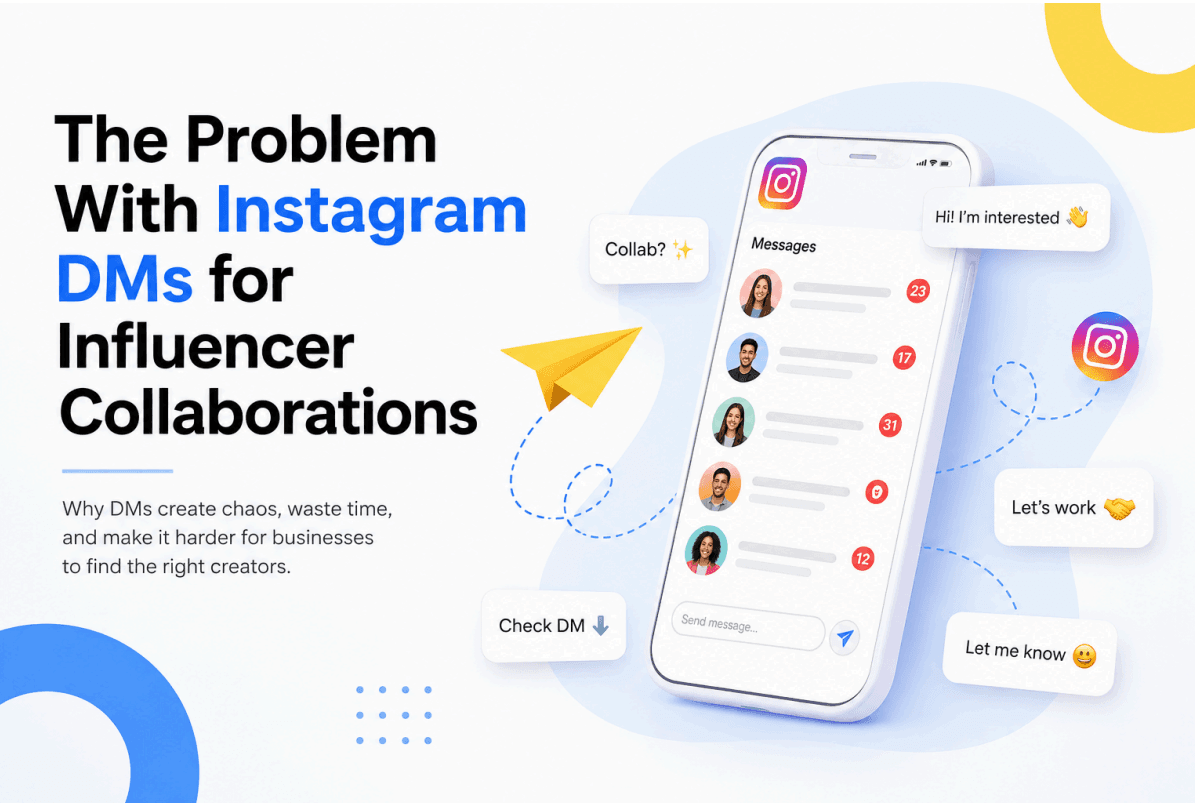
Influencer collaborations should not be this messy. Today, if a business wants to collaborate with creators, the process usually starts in the most unstructured way possible. They post a story, reel, or caption saying:
"DM for collaboration" "Creators, comment below" "Looking for influencers for our brand"
And then the replies start coming in. Some creators comment. Some DM.
Some send media kits. Some just write "Interested." Some are relevant.
Many are not. Some have good content but no proper pitch. Some have high followers but no real campaign fit.
Very quickly, the business is left with a messy inbox, hundreds of messages, scattered profiles, and no clear way to decide who is actually right. This is one of the biggest problems in creator-led marketing today. The issue is not that businesses cannot find creators.
The issue is that the process of finding the right creator is broken.
Instagram DMs were never built for campaign management.
Instagram is great for content discovery. But it was not built to manage business collaborations. A DM inbox cannot properly handle:
- campaign briefs
- creator shortlisting
- budget comparison
- deliverables
- timelines
- approvals
- payments
- creator performance
- past collaboration history
- follow-ups
- campaign tracking
Still, most businesses are forced to manage influencer collaborations through DMs because there is no simple structured system in between. This creates confusion for both sides. The business does not know which creator to choose.
The creator does not know whether the business is serious. And after a few messages, many conversations either get lost, delayed, or completely ignored.
Too many DMs do not mean better choices.
A business may think:
"If 500 creators message us, we will have more options." But in reality, more options often create more confusion. Imagine receiving hundreds of messages like:
"Interested" "Collab?" "Check my profile"
"Paid?" "Barter available?" "Please check DM"
Now the business has to manually open profiles, check content, compare followers, review engagement, understand niche, ask for pricing, ask for deliverables, and then remember who said what. This becomes extremely time-consuming. And because the process is so chaotic, businesses often end up choosing creators based on the easiest visible number:
follower count. But follower count alone does not tell whether that creator is actually right for the campaign.
The right creator often gets missed.
This is the part that matters the most. In a crowded DM inbox, the best creator may not always stand out. A growing creator with strong niche content may send a simple message and get ignored.
A creator with a smaller but highly relevant audience may get lost between hundreds of random DMs. A creator who is actually perfect for the campaign may never even be seen properly. This is bad for creators.
But it is also bad for businesses. Because the business may miss the creator who could have delivered better engagement, better trust, and better campaign results. The problem is not lack of talent.
The problem is lack of structure.
DMs create no real decision system.
When businesses choose creators through DMs, there is usually no proper comparison. There is no clean dashboard. No ranking.
No campaign fit score. No structured creator profile. No audience relevance check.
No budget-fit clarity. No past reliability information. So the business is left to make a decision based on scattered information.
One creator sends screenshots. Another sends a media kit. Another shares rates.
Another asks for barter. Another disappears after two messages. There is no standardized way to compare everyone.
This makes influencer marketing feel like guesswork. And that is a serious problem if businesses are spending real money.
Communication also becomes difficult.
Even after a business selects a creator, the problem does not end. The next stage becomes:
- What is the deliverable?
- How many reels?
- How many stories?
- What is the deadline?
- Who approves the content?
- When will payment happen?
- What if the creator delays?
- What if the business delays payment?
- Where are the files?
- What was finalized?
Most of this again happens inside DMs or WhatsApp. And when everything is scattered, misunderstandings happen. Sometimes creators feel the business is not responding properly.
Sometimes businesses feel the creator is not delivering on time. Sometimes payment discussions become uncomfortable. Sometimes deliverables are not clearly documented.
This is why influencer collaborations need a proper workflow, not just conversations.
Businesses need structure, not more messages.
The future of creator collaborations cannot depend only on Instagram DMs. Businesses need a system where they can:
- list their campaign requirement
- define budget
- mention target audience
- specify deliverables
- receive relevant creator applications
- compare creators properly
- shortlist based on fit
- manage communication
- track deliverables
- complete payments
- measure campaign outcomes
That is how creator-led marketing becomes scalable. Because a business does not just need people messaging them. A business needs clarity.
Creators also need a better system.
From the creator side, Instagram DMs are equally frustrating. Many creators send messages to businesses and never get replies. Some get shortlisted but never hear back.
Some complete work and then face payment delays. Some do not know whether the business is serious or just casually exploring. And many growing creators struggle to get noticed because they do not have huge follower numbers yet.
But creator quality is not only about followers. A creator may have:
- strong niche content
- loyal audience
- good storytelling
- high engagement
- authentic community trust
- strong editing or content skills
Still, they may get ignored because they are buried inside a DM inbox. That needs to change.
The real problem is discovery plus execution.
Most people think influencer marketing has only one problem:
"How do we find influencers?" But the actual problem is bigger. Businesses need help with:
- Discovery: Finding the right creators.
- Decision-making: Understanding who actually fits the campaign.
- Budget clarity: Knowing what is realistic for their budget.
- Workflow management: Managing deliverables, approvals, communication, and timelines.
- Trust: Reducing payment and execution issues.
- Tracking: Understanding what worked and what did not.
Instagram DMs solve almost none of this properly. They only start the conversation. They do not manage the collaboration.
This is why CollabKaro is being built.
At CollabKaro, we are building for this exact gap. We believe businesses should not have to depend on random DMs and comments to find creators. And creators should not have to depend only on cold messages to get discovered.
CollabKaro's goal is to help businesses discover the right creators and creative talent based on:
- niche
- content quality
- audience relevance
- campaign fit
- budget compatibility
- expected deliverables
- reliability
- business goals
Not just follower count. And long term, we want to go beyond influencer collaborations. Businesses do not only need influencers.
They may also need:
- UGC creators
- video editors
- graphic designers
- social media managers
- photographers
- content writers
- campaign support
So CollabKaro is being built as a more structured way for businesses to plan, find, execute, and track their marketing needs.
The future is not "DM for collaboration."
The future is structured creator discovery. A business should be able to say:
"This is my budget. This is my goal. This is my target audience. Help me find the right people." And the platform should help them understand:
- who to work with
- how to divide the budget
- what deliverables are realistic
- what kind of results they can expect
- how to manage the collaboration smoothly
That is the future we believe in. Instagram DMs helped creator collaborations begin. But they cannot be the system that scales them.
Final thought
DMs are good for conversations. But they are not enough for collaboration infrastructure. If businesses want creator marketing to become serious, scalable, and result-driven, they need something more structured than a messy inbox.
They need a system that helps them make better decisions. They need a system that gives creators fair visibility. They need a system that manages the full journey from discovery to execution.
That is what CollabKaro is building.